SIP Trunking Architecture in 2025 — A Practical Engineer’s Guide to Secure, Redundant, High-Quality Voice
SIP Trunking Architecture in 2025 — A Practical Engineer’s Guide to Secure, Redundant, High-Quality Voice
Summary: SIP trunking remains the backbone of modern enterprise voice. But in 2025, the difference between a brittle trunk setup and a resilient, compliant, high-quality architecture is massive. In this guide, we’ll go beyond the basics and show you how to design, secure, and monitor SIP trunks like a professional. You’ll find reference architectures, practical configuration snippets, redundancy patterns, compliance notes, and a full cutover checklist you can apply in production.Table of Contents
- Primer: From PRI to SIP Trunks
- Reference Architecture for 2025
- Security: TLS, SRTP, and Identity
- Resilience & Failover Patterns
- Quality & Performance Engineering
- Interoperability Pitfalls
- Compliance & Emergency Services
- Observability & Monitoring
- Cutover Playbook with Real Examples
- Practical Config Snippets
- Frequently Asked Questions
1) Primer: From PRI to SIP Trunks
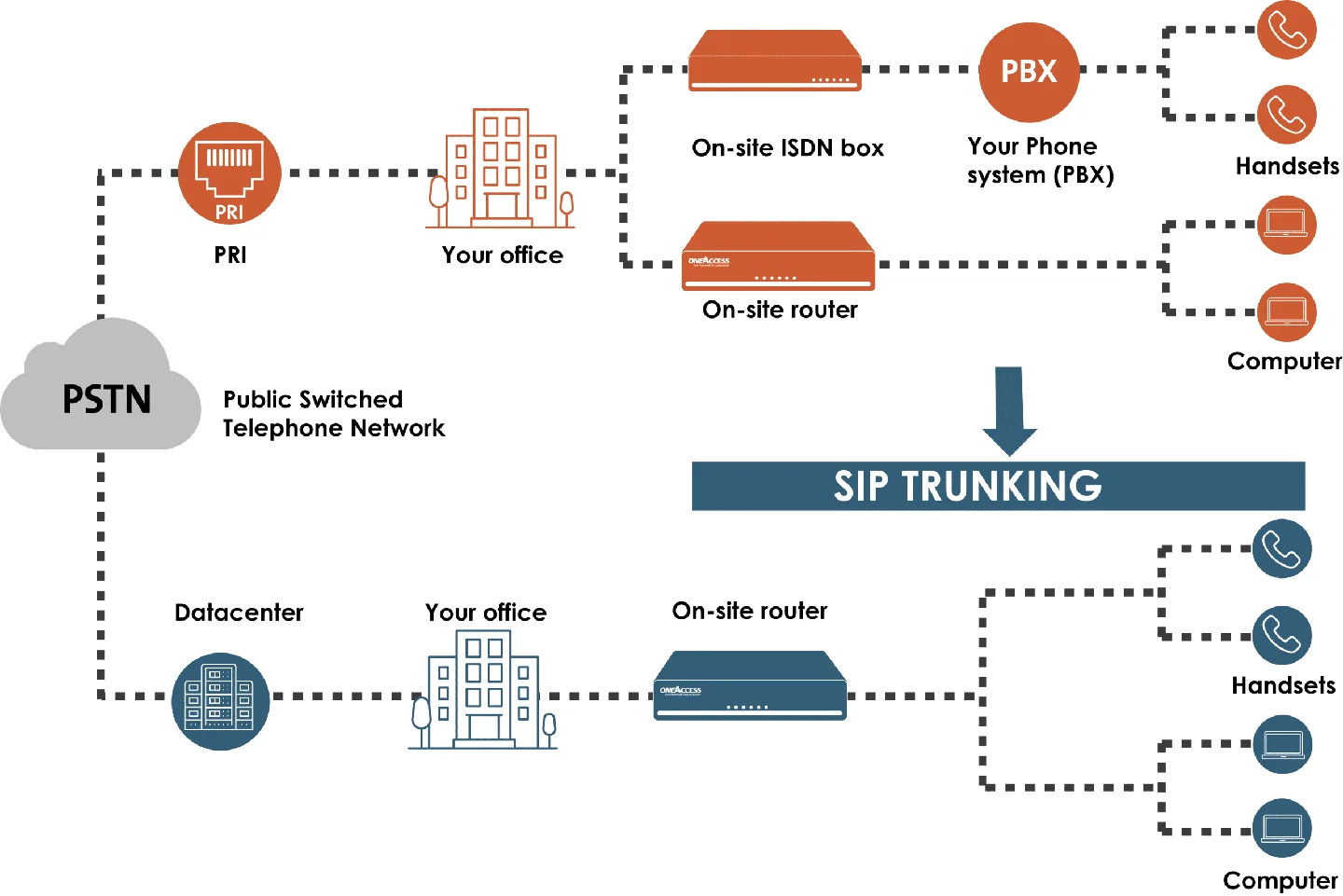
Not long ago, enterprises relied on PRI (Primary Rate Interface) or ISDN circuits for voice. Each circuit supported a fixed number of channels, scaling required more copper, and costs ballooned with international expansion. SIP trunks replaced this by running voice over IP — flexible, virtual, and scalable. In 2025, SIP trunks are more than just a replacement:- Cloud-first: PBXs are moving to the cloud (Teams, Zoom, CCaaS platforms), but SIP trunks still provide connectivity and redundancy.
- Compliance-driven: Regulations like STIR/SHAKEN (caller ID authentication) and E911 have made architecture decisions more complex.
- Global by default: Businesses expect to connect 50+ countries with local DIDs, something PRI could never support.
2) Reference Architecture for 2025
A resilient SIP edge looks like this:[Firewall / Edge Router]
↓
[SBC or SIP Proxy Layer (Kamailio, OpenSIPS, or SBC Appliance)]
↓
[PBX / UC Platform (Asterisk, FreeSWITCH, Microsoft Teams SBC, CCaaS)]
↓
[Agents, Phones, Apps, Call Center]
Key components:
- SBC / SIP Proxy: Provides security (topology hiding, ACLs, DoS protection), load balancing, and failover. Choose SBC (full B2BUA) if you need lawful intercept or complex policy enforcement. Use OpenSIPS/Kamailio if you want scale with flexible routing.
- PBX/UC: This could be Asterisk with PJSIP, FreeSWITCH, or a SaaS PBX. It handles call control, features, and user logic.
- Carriers: Multiple SIP trunk providers with DNS SRV for failover. Don’t put all eggs in one basket.
3) Security: TLS, SRTP, and Identity
In 2025, sending SIP over UDP port 5060 with cleartext RTP is unacceptable. Here’s what modern deployments require:- Signaling: TLS 1.2 or 1.3, with Let’s Encrypt/ACME automation for cert renewals.
- Media: SRTP (SDES) or DTLS-SRTP. Plain RTP is a liability.
- Authentication: Digest auth for endpoints; IP-based auth + mutual TLS for trunk peers.
- Identity: STIR/SHAKEN signing on outbound calls to prevent spoofing and ensure reputation.
Tip: Disable SIP ALG on your firewall — it breaks more calls than it fixes.
4) Resilience & Failover Patterns
SIP trunk failures happen: carrier maintenance, fiber cuts, DDoS attacks. The goal is not to avoid failures entirely, but to survive them gracefully.- DNS SRV & NAPTR: Configure multiple gateways with priorities and weights.
- SIP OPTIONS pings: Continuous health checks to detect unresponsive peers.
- 503 + Retry-After: Respect overload signals from carriers.
- Multi-POP Design: Deploy east + west coast SBCs, or EU + APAC, and steer calls regionally.
; Example DNS SRV for redundancy
_sip._udp.carrier.com. 3600 IN SRV 10 50 5060 sip1.carrier.com.
_sip._udp.carrier.com. 3600 IN SRV 20 50 5060 sip2.carrier.com.
5) Quality & Performance Engineering
Good SIP trunking is about more than “up or down.” You need to engineer for voice quality under load.- Key KPIs: ASR (Answer-Seizure Ratio), ALOC (Average Length of Call), PDD (Post-Dial Delay), jitter, MOS (Mean Opinion Score).
- Codecs:
- G.711: reliable baseline, but bandwidth heavy.
- Opus: excellent quality and resilience on lossy networks.
- G.729: still used for bandwidth savings, but licensing costs exist.
- Packetization: 20 ms is the sweet spot for most scenarios. Larger ptime reduces overhead but increases delay/jitter risk.
- QoS: Mark RTP with DSCP EF (46), SIP with CS5. Configure switches/routers to honor it.
6) Interoperability Pitfalls
Even with standards, SIP is notorious for edge cases. Common issues include:- DTMF: Use RFC2833 RTP Events. Keep SIP INFO as fallback, test both.
- Call Transfers: Some carriers reject REFER; others mishandle re-INVITE. Verify both in staging.
- Early Media: 183 Session Progress with SDP often required. Ensure PRACK support if carrier demands it.
- Large INVITE Packets: Use TCP or TLS signaling to avoid fragmentation when SDPs are large (e.g., video/Opus).
7) Compliance & Emergency Services
Voice is tightly regulated. SIP trunking architecture must embed compliance from day one.- STIR/SHAKEN: Outbound calls need signed caller IDs. Understand attestation levels:
- A = Fully verified (best reputation)
- B = Partial verification
- C = Gateway call (lowest trust)
- E911/112/999: Register accurate dispatchable addresses. For remote users, implement nomadic 911 solutions.
- Robocall mitigation: Use analytics, fraud detection, and volume monitoring to prevent labeling as spam.
8) Observability & Monitoring
A SIP trunk is only as good as its visibility. What to monitor:- Call stats: ASR, ALOC, PDD, CPS vs thresholds.
- Quality stats: jitter, MOS, packet loss, one-way audio counts.
- Signaling & media capture: Deploy Homer/HEP for SIP ladder captures.
- Dashboards: Prometheus + Grafana for KPIs. Set alerts: ASR drop >10% or CPS spike >30% = investigate.
9) Cutover Playbook with Real Examples
Migrating SIP trunks is risky. Here’s a playbook:- Canary Trunk: Move 1–2 DIDs to new carrier. Monitor 48 hours.
- Run Test Matrix: inbound, outbound, caller ID, DTMF, transfers, fax if needed.
- Monitor KPIs: Compare ASR/ALOC to baseline. Watch ticket volume.
- Phase Rollout: Move call center groups incrementally.
- Rollback Plan: Keep old trunks live. Fallback DNS to old gateways if needed.
10) Practical Config Snippets
Asterisk PJSIP (TLS + SRTP)
[transport-tls]
type=transport
protocol=tls
bind=0.0.0.0:5061
cert_file=/etc/asterisk/keys/asterisk.pem
priv_key_file=/etc/asterisk/keys/asterisk.key
method=tlsv1_2

[trunk-illyvoip]
type=endpoint
transport=transport-tls
aors=trunk-illyvoip
auth=trunk-illyvoip
context=inbound
disallow=all
allow=ulaw,alaw,opus
media_encryption=sdes
Kamailio Dispatcher (Failover)
modparam("dispatcher", "list_file", "/etc/kamailio/dispatcher.list")
modparam("dispatcher", "flags", 2)   # Round-robin
modparam("dispatcher", "ds_ping_interval", 15)
modparam("dispatcher", "ds_probing_mode", 1)

# dispatcher.list
1 sip:trunk1.illyvoip.com:5061 0 1 'Primary'
2 sip:trunk2.illyvoip.com:5061 0 2 'Backup'
Prometheus Exporter (SIP OPTIONS Health)
# Simple exporter logic
sip_options_latency_seconds{peer="trunk1"} 0.032
sip_options_latency_seconds{peer="trunk2"} 0.035
sip_options_failures_total{peer="trunk1"} 0
sip_options_failures_total{peer="trunk2"} 0
11) FAQs
What’s the difference between an SBC and a SIP proxy?
An SBC is a B2BUA — it terminates and re-originates calls, providing full control and hiding your topology. A SIP proxy (e.g., Kamailio/OpenSIPS) routes SIP messages without terminating calls. Enterprises often deploy both.Do I really need TLS and SRTP?
Yes. TLS protects signaling, SRTP protects media. Carriers, regulators, and customers increasingly expect encrypted calls by default.How do I test SIP trunk failover?
Force an outage (block IP or stop process) and observe DNS SRV failover, SIP OPTIONS rerouting, and 503 Retry-After behavior. Document results for audits.Already a customer? Log in to manage trunks and monitor performance. Learn more about IllyVoIP Voice features.